what is the term used to describe the life cycle of plants?
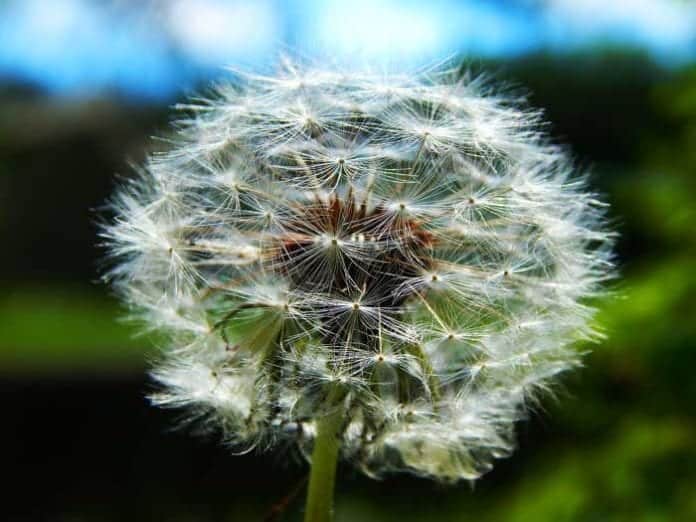
Plant Life Cycle: Plants, like any other living organisms, have their specific developmental history. Specifically, plants exhibit a and then-called haplodiplontic life cycle wherein the gametes (sex cells) are non a straight product of meiosis.
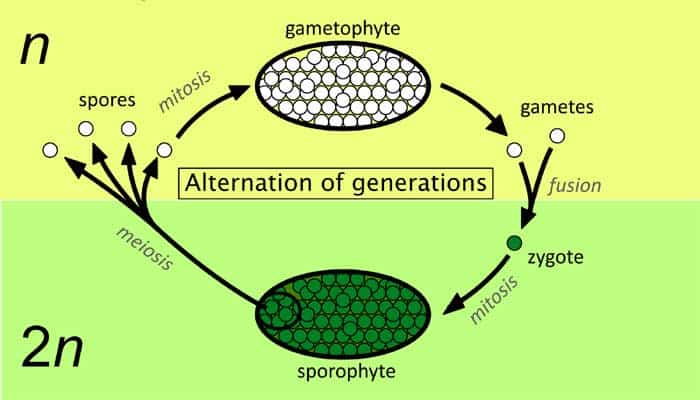
Instead, diploid sporophyte cells get through meiosis and produce the haploid spores. Each spore then mitotically divides in order to produce the haploid gametophyte which so yields the gametes. The gametes then undergo fertilization in guild to produce the zygote.
Throughout their life bicycle, all plants undergo the alternation of generations. This wheel of generations include both diploid (2n) stage (i.due east., having 2 sets of chromosomes), the sporophyte, and the haploid (n) stage (i.e., having only i set of chromosomes) gametophyte.
In this article, we volition effort to wait at how these generations differ with each other and how they occur in unlike types of plants.
Tabular array of Contents
- Plant Life Bicycle: Alternation of Generations
- The Sporophyte Generation
- The Gametophyte Generation
- Difference Between Sporophyte And Gametophyte Generation
- Comparison With Other Organisms
- Life Bicycle of Dissimilar Plant Types
- ane. Life Cycle of Bryophytes (Mosses Plants)
- 2. Life Bicycle of Pteridophytes (Fern Plants)
- three. Life Cycle of Angiosperms (Flowering Plants)
- References
Plant Life Bike: Alternation of Generations
The Sporophyte Generation
 As its name suggests, the function of the sporophyte phase is to generate the spores through meiosis. It is important to annotation that the sporophyte is diploid (2n) and in order to produce the haploid (n) cells, which comprise one-half the number of chromosomes, meiosis division should occur.
- In the sporophyte phase, meiosis occur in the sporangium (plural: sporangia).

The Gametophyte Generation
The gametophyte begins with the spore produced from the sporophyte stage. Basically, the main goal of gametophyte generation is the production of the gametes, sperm and egg.
- In this phase, ii distinct sexual activity organs are produced: the antheridium (in males) that produces sperm, and the archegonium that produces the eggs.
- The sperm and egg then combine to course a unicellular zygote that will split mitotically to produce the multicellular sporophyte.
Difference Between Sporophyte And Gametophyte Generation
The table below summarizes the differences between the ii generations in the plant life bike.
| Feature | SPOROPHYTE | GAMETOPHYTE |
|---|---|---|
| TYPE OF REPRODUCTION | Asexual reproduction (but the somatic cells are involved) | Sexual reproduction (merely the sexual activity cells or gametes are involved) |
| TYPE OF CELL Division | Meiosis | Mitosis |
| OFFSPRING | Spores | Gametes (sperm and eggs) |
| NUMBER OF CHROMOSOMES | Diploid (two copies of each chromosome) | Haploid (ane re-create of each chromosome) |
| Start Prison cell PRODUCED | Diploid zygote | Haploid spore |
| OCCURRENCE IN PLANTS | In lower plants like Bryophytes, Lycophytes, and Psilophytes, the sporophyte depends on the gametophyte. In Angiosperms, the sporophyte stage is longer as compared to the gametophyte stage. | In lower plants like Bryophytes, Lycophytes, and Psilophytes, the gametophyte is longer than the sporophyte phase. In Angiosperms, the gametophyte phase is shorter equally compared to the sporophyte phase. |
Comparing With Other Organisms
Unlike plants which undergo through mitosis in both diploid and haploid generations, creature life cycles simply involve mitosis in the diploid phase. In this case, plants have a haplodiplontic life cycles whereas animals accept the diplontic life cycles.
Life Cycle of Different Plant Types
i. Life Cycle of Bryophytes (Mosses Plants)
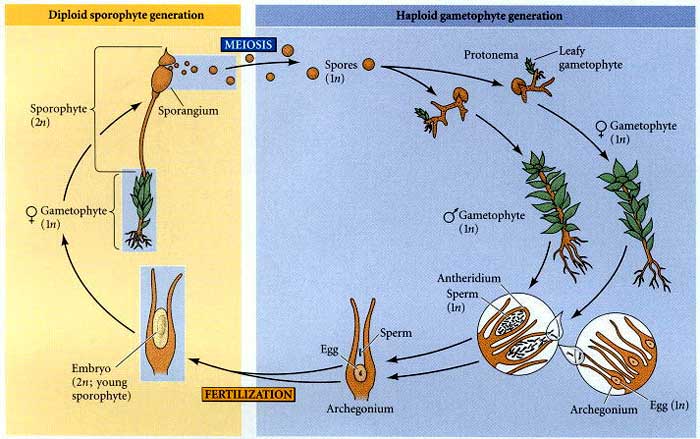
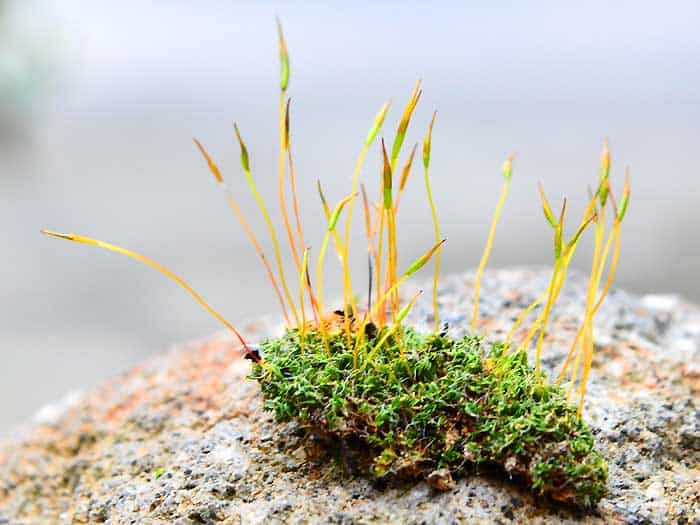
In mosses, like the Polytrichum, the sporophyte stage by and large depends on the gametophyte for its nutrition. Mosses produce two unlike types of spores and these distinctly develop into male and female person gametophytes. Considering of this, mosses are considered to be heterosporous.
- Based on the diagram above, cells in the sporangium (sporophyte) divide through meiosis in order to produce spores (males and females).
- After that, each kind of spores respectively divides through mitosis to produce male and female gametophytes.
- At maturation, the gametophytes then differentiate into antheridia (males) and archegonia (females).
- In these places, mitosis occurs following the production of the sperm and eggs.
- After the sperm and egg meet, the sporophyte generation grows in the archegonium and is fastened to the gametophyte.
- Interestingly, the "leafy" advent of the mosses nosotros see is in fact the gametophyte phase of the plant.
2. Life Cycle of Pteridophytes (Fern Plants)
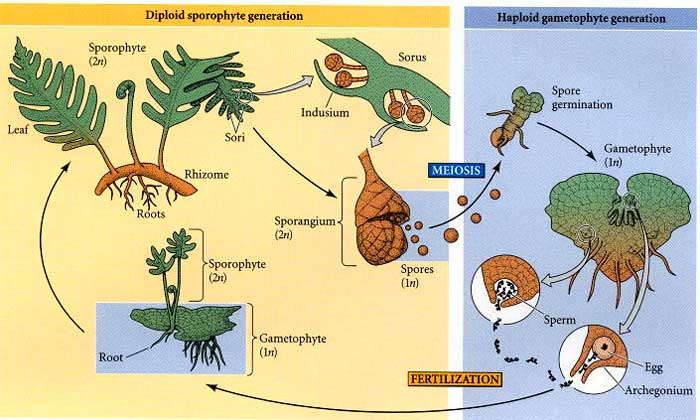
Ferns and fern allies are members of a group of plants called the Pteridophytes. Basically, ferns and fern allies, and mosses undergo most similar developmental patterns. However 1 major deviation between the two is that most ferns are considered to be homosporous. Meaning, only one type of spore (called the sporangium) is produced by the sporophyte, and only one gametophyte is needed to develop the male and female sex organs.
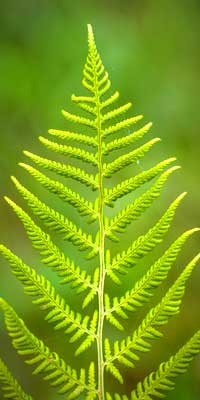 Another major divergence betwixt them is that both generations in the life cycle of ferns are autotrophic (can undergo photosynthesis).
- Based on the diagram above, the sporophyte generation is the more ascendant phase and thus is independent of the gametophyte generation.
- Basically, the sporangia are covered by the indusiumand are birthday contained within the sorus (plural: sori). The spores are so produced when the sporangia undergo meiosis.
- After that, each spore mitotically divides in order to produce the gametophyte that matures into antheridia (male) and archegonia (female).
- The gametophyte generation is smaller than the sporophyte but is equally important because it is where fertilization takes place. Commonly, when h2o is nowadays, the sperm in the antheridia swims to the eggs in the archegonia.
3. Life Bicycle of Angiosperms (Flowering Plants)
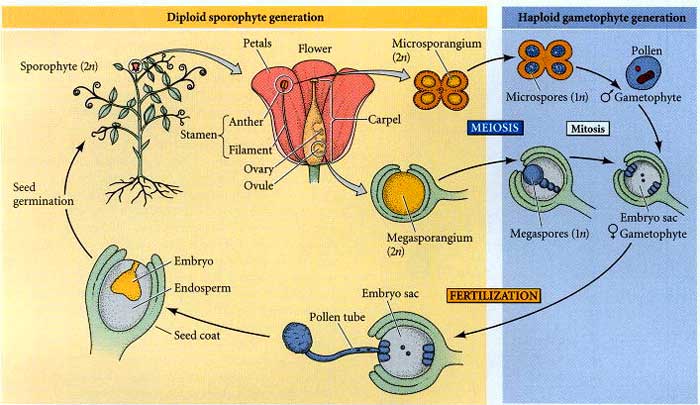
Angiosperms, or all flowering plants, may expect like they accept a diplontic life bicycle because the gametophyte stage is just exhibited by very few cells. However this is not true because mitosis still follows meiosis during the sporophyte phase, creating a gametophyte that can produce either the sperm or the egg.
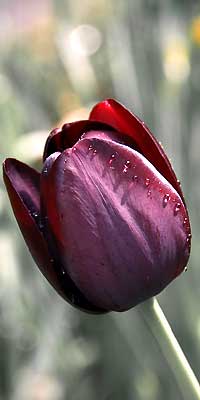 These events have place inside the organ that distinguishes angiosperms from all other plant types: the flowers.
- In angiosperms, the sporophyte is more ascendant than the gametophyte generation. However, the male and female gametophytes are produced in the flowers during the sporophyte generation.
- In the anther (male), cells of the microsporangium divide through meiosis in order to create the microspores. A separate partitioning through meiosis is exhibited past the megasporangium in the ovary (female person) in order to produce i large megaspore and three small ones. Despite this, merely the large megaspore lives in order to be fertilized.
- It is important to note that the sporophyte phase can be kept dormant when the embryo (eventually the seed) is covered by the seed coat.
Basically, we have seen how plant life bicycle alternate between the two generations: the product of the embryo from the fusion of gametes in the gametophyte phase, and its evolution that occur in the sporophyte phase. Hence in gild to correctly sympathize establish development, one must really constitute the knowledge about the ii.
Now, after going through the different life cycles of different types of plants, tin can yous figure out why there are no moss trees?
HINT: It has something to do with its haploid gametophyte phase.
Cite This Folio
References
- [1] – "Life bicycle – New Globe Encyclopedia". Accessed February 05, 2017. Link.
- [2] – "Plant Life Cycles – Developmental Biology – NCBI Bookshelf". Accessed February 05, 2017. Link.
- [3] – "Sporophyte: Definition & Examples – Video & Lesson Transcript | Report.com". Accessed Feb 05, 2017. Link.
- [4] – "Life cycle – New World Encyclopedia". Accessed February 05, 2017. Link.
- [5] – "Angiosperms". Accessed February 05, 2017. Link.
- [6] – "Figure 20.2, [Life bike of a moss]. – Developmental Biology – NCBI Bookshelf". Accessed February 05, 2017. Link.
- [7] – "Figure 20.three, [Life cycle of a fern]. – Developmental Biology – NCBI Bookshelf". Accessed Feb 05, 2017. Link.
- [viii] – "Figure xx.4, [Life cycle of an flowering plant]. – Developmental Biology – NCBI Bookshelf". Accessed Feb 05, 2017. Link.
Source: https://www.bioexplorer.net/plant-life-cycle.html/
0 Response to "what is the term used to describe the life cycle of plants?"
Publicar un comentario