chevy volt what to do when in flood
Equally a Chevy Volt owner for over seven years, I completely sympathize why many Volt owners are upset at the news that GM was cancelling the Volt and not pursuing whatsoever other Voltec-based vehicle platforms. Thank you to a fervent and vocal anti-GM enclave of the EV community, the Volt'southward counterfoil prompted renewed claims that GM was – once again – attempting to "kill" the electrical car. These accusations gained additional traction thanks to GM's not having an firsthand, plug-in replacement for the Volt. However, from an objective viewpoint, GM'due south decision to cancel the Volt and the Voltec plan was correct.
In this story, I will explain why GM was right to end the Volt programme, their reasons for not applying the Voltec powertrain to other platforms, and the reasons the electrical vehicle community shouldn't be concerned about GM "killing" their electric cars. However, I will also explain what GM did wrong by cancelling the Volt program in the way they did and what they could take (and should have) done differently.
The Chevy Volt Cost Also Much To Build
While GM is often painted as an evil corporation bent on the devastation of humanity, the reality is that they are a profit-driven company that owes primary fidelity to its investors. Regardless of their affinity for a brand, concept, or vehicle, they have to demonstrate to their investors either immediate profits or – at the very least – a pathway to profitability. Through that lens, maintaining the Volt and Voltec programs made admittedly no sense.
The Chevrolet Volt is extremely complex and expensive to build, and its supply chain looked like someone threw a pile of spaghetti noodles onto a map of Michigan that spilled off onto the rest of the Midwest. These complicated supply chains fabricated information technology difficult to build Volts profitably, and equally a low-volume, low-margin vehicle, it was destined for the chopping cake.

The only matter that was saving the Volt from what would accept normally been an easy determination to cancel the program were the zilch emission vehicle (ZEV) credits that starting time GM's cost for building the Volt. Yet, even if Corporate Average Armada Economy (Buffet) standards and ZEV credit system remain in place (which is no longer even sure), a plug-in hybrid electric vehicle (PHEV) such as the Volt provides GM with increasingly fewer ZEV credits over fourth dimension. Essentially, as ZEV requirements become stricter, the financial benefits GM sees from building PHEVs decreases.
With the release of Chevrolet Bolt EV, which would exist responsible for earning the panthera leo'due south share of GM'southward ZEV credits, the Volt programme in the United States became very hard to justify. What is more than, while there was a clear pathway to profitability for the Bolt EV; even so, the same could not be said for the Volt.
The Chevy Volt Offered No Pathway to Profitability
An all-electrical auto like the Chevrolet Commodities EV has a clear path to profitability. Fifty-fifty if the ZEV credits end completely, the only matter keeping the Bolt EV from being highly profitable was battery prices. Co-ordinate to a UBS tear-down written report of the 2017 Chevy Bolt EV, it cost GM $28,700 in parts and labor to build. That ways that, at the leaked $145 per kWh price that GM was paying LG for bombardment cells, the Chevy Commodities EV'due south bombardment lonely represented more than ane 3rd of the total price to build the Bolt EV.
However, with battery prices projected to fall well beneath $100 per kWh in the near future and GM's moving electronic component manufacturing facility in Hazel Park, MI, the Bolt EV's pathway to profitability was obvious. By 2021, the Chevy Commodities EV's battery price of $100 per kWh would relieve GM near $2,000 in manufacturing costs, despite existence projected to exist more capable in terms of both energy and charging speeds.

The Chevy Volt, on the other manus, owed its manufacturing cost to more than simply the battery. While it's truthful that there was some room to ameliorate the Volt while still lowering costs over time (as GM had already been doing throughout the Volt's history past moving outsourced manufacturing to the United States, improving the bombardment, and reducing the use of rare globe elements), the price reduction floor was withal much higher in the Volt than in the Commodities EV.
Considering the Volt was burdened with both an electrical powertrain and an internal combustion powertrain that offered fewer opportunities for price reduction, the Volt could never achieve the same profitability as either a pure internal combustion vehicle or a pure battery electric vehicle.
The Chevy Volt's Appeal Was Too Express
Some Volt proponents noted that it actually had similar U.S. sales numbers to the Chevy Bolt EV, so if GM was fine keeping the Bolt EV around, they should also keep the Volt effectually. As I noted above, cost and lack of profitability were key considerations; however, the Volt's low sales numbers did too contribute to the decision. Though the Bolt EV and Volt'due south domestic sales numbers were close, GM is a global visitor, and simply put, the Bolt EV has broader appeal and more widespread demand than the Volt.

First, the raw U.S. sales numbers for the Bolt EV and Volt did non provide an accurate representation of demand. The Commodities EV was really supply constrained while the Volt had no such limitations. Many prospective customers were complaining about the availability of the Bolt EV. While it's true that GM was over delivering Bolt EVs to California (dealership lots full of Bolt EVs made it announced as though demand for the Bolt EV was not as high); however, the Bolt EV delivery numbers outside California were oft and then low that it was near impossible to secure a test bulldoze. Most not-California Bolt EVs were sold before they even arrived at the dealership lot.
Early on, the need for the Bolt EV outside of California was and then high, in fact, that GM had to intervene to terminate California dealerships from selling direct to out of land buyers. The Bolt Stats! website yet has a group called "The Bolt Smugglers" that is made up of Bolt EV owners who were able to take Bolt EVs shipped to them before California dealerships were directed to cease the practice.
The Chevrolet Volt, on the other hand, had no such constraints. While some Chevy dealerships did refuse to conduct whatsoever plug-in vehicles, the Volt was widely bachelor across the country, and after 8 years on the marketplace, information technology failed to gain whatsoever meaning traction in the market. Despite the Volt's winning numerous awards and GM dedicating several extremely expensive Super Basin commercials – some of them were pretty good, also – the Volt failed to win significant market place share.
Once more, GM is a global visitor, and the strange markets were even less friendly to the Volt than the U.s.a.. GM had loftier hopes for the Volt program in Australia and Europe; yet, the Holden Volt and Vaxhull/Opel Ampera (European Volt) programs were abject failures. Over the grade of four years, only 246 Volts were sold in Commonwealth of australia, and total European sales for that period barely hit v figures.
Those markets rejected the Volt outright, so GM soon shut down deliveries to those regions. In fact, a potent argument could be made that it was the Ampera'southward failure in Europe (a market that was already heavily shifting to electric vehicles) that influenced GM's decision to sell off their Opel brand to PSA Group. And again, while GM could barely sell the Ampera in Europe, at that place was really a waitlist for the Ampera-E (Bolt EV). In fact, one of the biggest lasting criticisms of GM in the European market at this point is that failed to deliver on their promised Ampera-Es.
Why the Voltec Powertrain Doesn't Work for Larger Vehicles
A number of Voltec fans have stated that they understood why GM might exist moving abroad from small cars due to declining sales and lack of interest; yet, those aforementioned proponents also demand that GM use the Voltec powertrain in larger vehicles such as trucks and SUVs. In that location'southward only one problem: It doesn't work.
The Voltec organisation is designed to be all-electric, then the owner only uses the gas engine when absolutely necessary. Unlike the BMW i3's range extender, which is so small that it struggles to maintain freeway speeds when the battery is completely depleted, the Volt's range extender is perfectly matched to the Volt'south energy depict at lxx to eighty mph state highway speeds. That twoscore or and then horsepower of constant power draw falls well within the Volt generator's 74 horsepower max output.
The Voltec system works well in a car like the Volt considering the car is small-scale and aerodynamic. This ways that, even when the small bombardment is completely depleted, the Volt can maintain highway speeds using only the gas engine and generator. Withal, in those scenarios, the Volt is literally running at half power, with a pocket-size buffer in the battery for brusque surges of power. Deplete that buffer, however, and the Volt drops into Reduced Power mode. Even in the small, aerodynamic Volt, maintaining freeway speeds up a significant grade tin can be a struggle, especially nether reduced power.
Undaunted, Voltec proponents besides signal to Toyota's plug-in hybrids every bit evidence that GM could apply the Voltec platform to larger vehicles. For example, at the LA Auto Testify, Toyota recently unveiled the RAV4 Prime, which tin attain 39 miles of driving on electricity alone using Toyota's plug-in Hybrid Synergy Drive (HSD) engineering. The trouble is, Toyota's HSD is fundamentally different than the Voltec system.

Toyota's HSD emphasizes the internal combustion engine over the electrical motor organization. For example, the Toyota Prius Prime's internal combustion engine alone is capable of outputting 93 hp while the two onboard electric motors can only combine for 91 horsepower. Essentially, Toyota's plug-in hybrid organization is designed to run off the gas engine under all circumstances but off the electric propulsion system only nether limited circumstances. That's the exact contrary of the mode the Voltec system works in the Chevy Volt.
In other words, in order to achieve what Toyota is doing with their HSD, GM would demand to fundamentally change the Voltec architecture. It would lose its essence equally an electric vehicle powertrain with a gas generator fill-in, and it would become just some other hybrid. To support a larger format vehicle – an Equinox, for argument's sake – the range extender couldn't merely be proportionally bigger because the power required to overcome aerodynamic elevate would be far higher in a larger vehicle.
For an Equinox sized vehicle, the range extender couldn't exist same one-half-peak-power configuration used in the Volt if it is to be capable of overcoming drag at freeway speeds. Rather, it would likely demand to exist at least 2 thirds to three quarters of peak ability. So if a Voltec Equinox had a 150 kW (200 hp) main drive motor, the backup generator would probable need to be at least 100 kW (134 hp). That represents significantly college costs, increased weight, and larger powertrain volume. These result from a larger engine (possibly a six cylinder like the Pacifica Hybrid – another plug-in hybrid that is simply partial electric) to a larger fuel tank required to support lower fuel economic system.
This is before whatsoever considerations are fabricated for towing or other heavy loads, and this is in the Equinox, which is a relatively efficient midsize SUV. The Voltec organization would scale even more poorly for larger, less efficient SUVs, and it definitely wouldn't work for trucks. At that point, at that place would need to exist parity between the power output of the master electric drive motor and the gas generator, pregnant it would be more effective on all fronts to simply make a standard series hybrid with no secondary motor/generator. The outcome would be similar to the Chevrolet Tahoe Hybrid, which was anything but a success story.
Chevy Volt's Manufacturing Facilities to Be Used for Electric Trucks
In regards to the argument that GM'due south ending the Volt and Voltec program are somehow incongruous with an "all-electric" future, I heartily disagree. Ane but needs to wait at how GM has followed up since that annunciation. While it's truthful that GM didn't have an immediate, plug-in replacement for the Chevy Volt (more on that below), everything else they accept done is demonstrating a movement toward all-electric vehicles.
For example, GM is converting the shuttered Detroit-Hamtramck plant (where the Chevy Volt was built) to build electric vehicles. The manufacturing plant is currently beingness retrofitted and retooled in guild to build three upcoming, all-electrical offerings: An Escalade SUV, a Sierra truck, and a Hummer SUV. GM is spending $300 million to retool their Orion facility (where the Chevy Bolt EV is built) so that they can build their upcoming midsize, all-electrical offering, currently being referred to as the "Bolt EUV."
For these larger format vehicles, the elegance and simplicity of an all-electric powertrain far exceeds what could be washed with whatever variation of a hybrid drive organization, plug-in or otherwise. That is especially true in the case of a vehicle like an Escalade EV. Only imagine what would happen if a Voltec powertrain was scaled upward and used in a Cadillac Escalade EV, and and then compare that to a competing all-electrical such as the Rivian R1S. It's really no contest at this point; a 300 to 400 mile all-electrical SUV presents a far greater value proposition than a hybrid SUV that is sometimes electrical.
The argument that GM isn't really serious nearly these larger electric vehicles falls autonomously further when considering that GM invested $2.3 billion in a articulation venture with LG to build a battery production facility in Lordstown that will capable of producing 30 GWh of batteries per year. Fifty-fifty at 150 kWh per big truck or SUV (a good estimate, in my opinion), GM would be able to produce equally many as 200,000 of these big-format EVs each yr.
What GM Should Have Done with the Chevy Volt
One surface area where I practise agree with GM's critics is their concerns nearly how GM ended the Volt plan. Substantially, they killed off the Volt before they had a ready, all-electric replacement. While the Chevrolet Commodities EV is a great multipurpose electrical vehicle and an first-class runabout, it's not as capable at motorway speed, long distance travel as a smaller, more than aerodynamic electric sedan would be (east.g., the Hyundai Ioniq Electric or Tesla Model 3).
The Volt'southward hatchback sedan format was a high-efficiency platform that would perform well as an all-electrical, long distance vehicle. If they connected using the same Volt platform, GM would need to go creative with how they packaged the battery for an all-electric Volt (such as what Opel did with their Corsa-e or Porsche did with the Taycan), but dropping the internal combustion engine and supporting components (in particular, the fuel and exhaust organisation) would open up up enough volume to add significantly more energy capacity.

GM already demonstrated that they accept improved their bombardment chemistry with the new 2020 Chevrolet Commodities EV's battery achieving 150 Wh/kg of energy density at a pack level. If GM could observe enough room for fifty-fifty a 50 kWh battery pack (again, similar to the Opel Corsa-e), an all-electrical Chevy Volt could easily exceed 200 miles of range, even at freeway speeds.
This Chevy "Volt EV" wouldn't be the well-nigh compelling electric vehicle, simply GM could sell it for a lower toll. Plus, it would be positioned very well against something like Hyundai'due south recently refreshed Ioniq Electric with 180 miles of range.
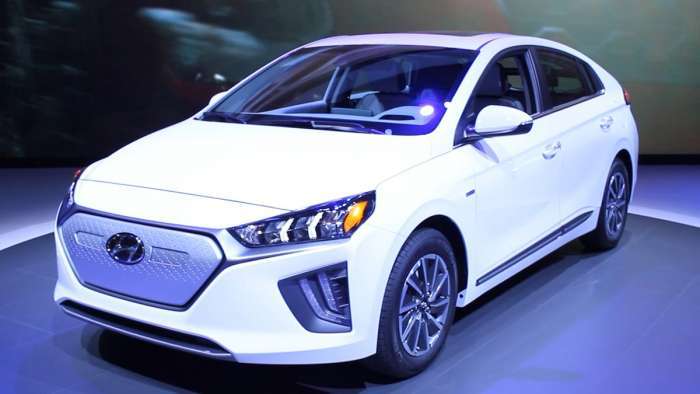
In my opinion, the better pick would have been to but adjust the BEV2 chassis (which is already used in the Chevy Commodities EV) to an existing sedan format. My preference would be the Chevrolet Malibu, which would easily achieve 300 miles of EPA range, even with a pocket-size lxx kWh bombardment pack. This would too meliorate marshal with customer expectations as shared by GM President Mark Reuss in a recent commodity, though it still wouldn't resolve the issue of upfront price parity with an internal combustion vehicle.
Some Volt Owners Are Still Fond to Gas
Still, information technology appears that for many of the Volt owners who are nigh critical of GM'southward decision to stop the Voltec plan, even a 300-mile all-electrical sedan wouldn't be skillful plenty. Whether this is because they live in an surface area where they feel the public charging infrastructure is insufficient or they simply aren't aware of what is available because they are even so fueling with gas on long trips, these drivers are insistent that GM needs to go on downwardly the plug-in hybrid path.

For those Voltec and plug-in hybrid proponents, I can only say that they might want to simply stick with gasoline. Based on my experience, the Volt and other plug-in hybrids only fit a very narrow fix of driving needs, and more than plenty Volts have already been produced to serve that market.
As a Volt owner, I fully appreciate the tens of thousands of all-electric miles of driving I was able to do in the Volt. Even when the infrastructure wasn't in place and I couldn't afford any of the longer range all-electric vehicles capable of coming together my demanding driving needs, the Volt was an choice. But times accept changed, and even for demanding drivers such as myself, at that place are all-electric vehicles that are more than cost-effective while being fully capable of meeting most people's driving needs.
If, as a Volt driver, you lot rarely exceed the all-electric range, it's very likely that a number of similarly priced all-electric vehicles that are currently on the market would serve your needs improve than the Volt. Not simply are there a number of functionally different vehicle formats to choose from, you may never demand to plug these vehicles in away from home or work. A number of Chevy Bolt EV and Hyundai Kona Electric owners I know accept still never had to apply the public charging infrastructure.
On the other hand, if you lot always run past the Volt'southward generous all-electric range, it's very likely that a number of cheaper or similarly priced vehicles would better suit your needs. Whether information technology be more efficient hybrids with most 20% better freeway fuel economic system than the Volt or all-electrics with four to v times the Volt'southward electric range, there are other, maybe improve, options. I understand that driving a standard hybrid doesn't comport the aforementioned cachet as driving an "electric," but burning that much gas in a Volt really makes information technology nil more than an expensive, inefficient hybrid.

One of the primal reasons I got the Chevy Commodities EV was because, in my regular routine, I was burning at least half-dozen gallons of gas a week in my Volt. When I threw onto that my regular road trips, I was easily called-for 30 to xl gallons of gas a month in a motorcar that'due south supposed to be primarily electric. Even my mother (to whom I gave my Volt) is going through at least one 9 gallon gas tank a calendar month, and she doesn't even drive it that often.
I also empathise that going fully electrical can exist daunting because of its learning curve and lack of familiarity. And aye, in some parts of the country, the public charging infrastructure simply doesn't support long distance travel in a fully electric vehicle. Withal, those aren't the geographical areas where the Volt was selling well anyway. A majority of Chevy Volts were sold in California where, despite delays and interference from permitting offices and public utilities, the public charging infrastructure is more robust than anywhere else in the nation.
Essentially, if you tin't make an all-electric work in a state like California, you'll probably exist stuck burning gas for a very, very long time.
Decision
To me, information technology'south clear that GM made the correct, pragmatic decision in ending the Chevrolet Volt and Voltec programs. While they could have held onto manufacturing the Volt a piddling longer, between working through a UAW strike and retrofitting the Detroit-Hamtramck facility, we're only talking a few more months' worth of production. Information technology'southward also articulate that this is not an indication of GM backing off on electric vehicles, but rather, it is evidence that GM is more committed than e'er to building all-electric platforms across their brands and lineups.
While I do agree that GM needs a sleek, efficient plug-in sedan in their lineup in order to beginning i of the biggest EV weaknesses (high-speed driving range), I disagree with pursuing internal combustion range extending technology any further. It's simply a waste, and the Voltec platform itself was incongruous with an "all-electric future."
Encounter you side by side time every bit I give my perspective on Tesla's holiday Supercharger queues!
About The Author
Eric Way focuses on reporting expert opinion on GM make electric vehicles at Torque News. Eric is likewise an instructional designer and technical writer with more than 15 years of writing experience. He besides hosts the News Coulomb video web log, which focuses on electrical vehicles, charging infrastructure, and renewable energy. Eric is an active member of the EV Advocates of Ventura County, a volunteer organization focused on increasing the widespread adoption of electrical vehicles. Yous can follow Eric on News Coulomb Youtube, on Facebook at @NewsCoulomb as well as on Twitter at @eway1978.
Source: https://www.torquenews.com/8861/gm-was-right-stop-making-chevrolet-volt
0 Response to "chevy volt what to do when in flood"
Publicar un comentario